01 · Open Brain

Memory that lives between all my tools.

A memory layer that hangs off all my applications through MCP and records how I work. Every session starts with context instead of from scratch, and after months of use the system suggests its own skills and tasks.

In production

Role

Architect & builder

Timeline

2 days to v1, 6 months of evolution

Team

Solo build

Stack

Claude Code · PostgreSQL · MCP · Railway

01 · the problem

Every tool has memory. None of them share it.

If you work with more than one AI tool, you know the feeling. What you told Claude on Monday is invisible to the rest by Tuesday. You start every conversation over with the same explanation. Each vendor builds memory inside its own walls, nobody builds the bridge between them. That is exactly where the friction sits in a multi-agent workflow.

I started Open Brain in January 2026, when MCP was still early. The bet: an open layer beats a vendor feature. Six months on, the layer is still running, and the architecture holds up.

01

Lock-in

Anthropic remembers Claude, OpenAI remembers ChatGPT. Neither builds the bridge to the other. Your context is trapped per vendor.

02

No ordering

Pure semantic search over raw notes quickly becomes a wall of loosely related text. Without typing, you can no longer find anything.

03

No decay

Everything weighs the same forever. A scratch note from March sits next to a decision from May. That is how a memory smothers itself.

If you use more than one AI tool, you already have this problem. Whether you feel it yet or not.

02 · the substance

Not how much it remembers. What it remembers.

Measuring a memory in numbers says nothing. The value sits in the content of what stays, typed and weighted, ready for the next session.

Decision

Open Brain builds on MCP plus a REST fallback, so every tool reads the same source, protocol-aware or not.

15 Jun 2026
Pattern

Dusty sometimes loses himself in the build while the business actions pile up. Flag it the moment the tendency shows.

recurring
Insight

Pure semantic search over raw thoughts quickly turns to noise. Typing and decay keep the memory sharp instead of full.

May 2026

This is what a screenshot doesn't capture. Open Brain is an invisible product, it sits between and behind everything. What you see here isn't a screen, but the content that travels along: typed by kind, weighted by importance, filtered by decay so a scratch note from March never ends up above a decision from May.

03 · up close

The application itself, in production.

Six screens, each with its piece of the story above it: how it works, and what it solves.

01 · Brain

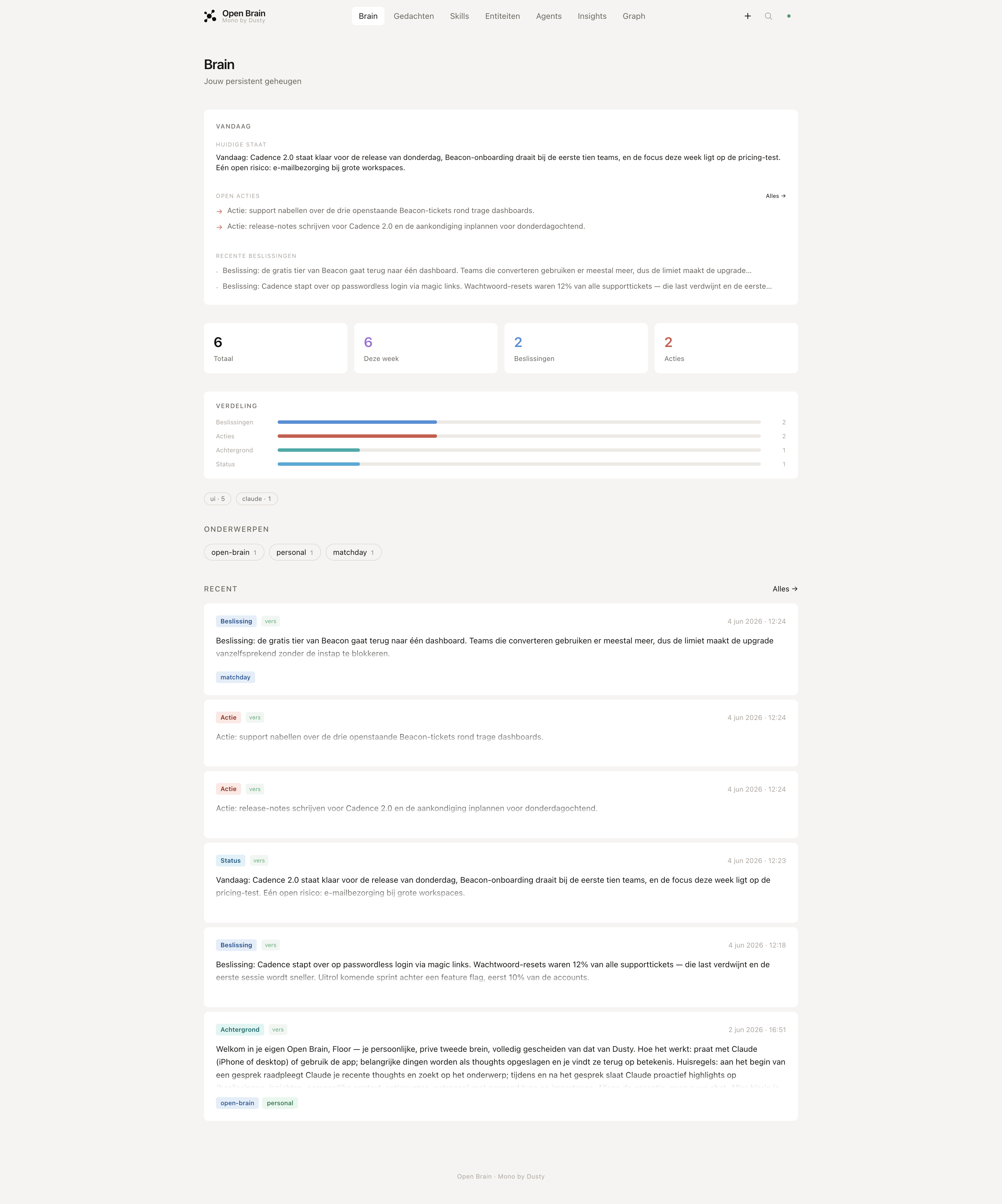
Every session starts with context, not from scratch.

The daily overview. What's in play, split by type, with the recent topics up top. The agent opens with this and knows straight away where you left off yesterday.

Key takeaway

No more chat you open with the same explanation, over and over.

Open Brain — Brain
Todayall →
412
Total
6
This week
14
Decision
5
Action
Decision14
Pattern9
Insight6
open-brainmemortiumhuntercosmo-os
02 · Graph

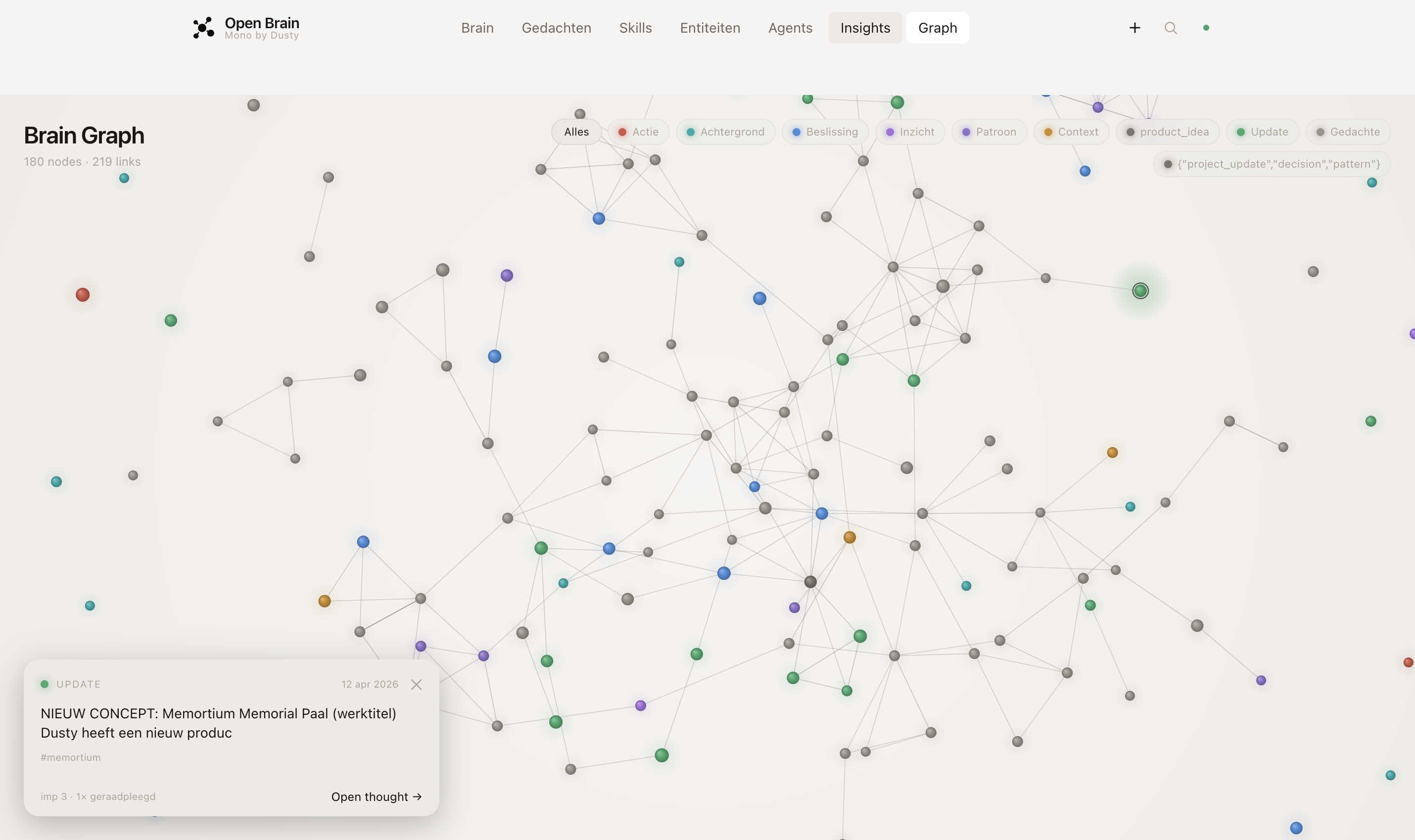
Connections you never see in isolation.

Every thought is a node, every relation a line. Themes form on their own, and a decision from months back suddenly turns out to touch what you're working on now.

Key takeaway

Knowledge no longer sits scattered across ten tools, but as one web you can query.

Open Brain — Graph
112 nodes · 219 links
03 · Insights

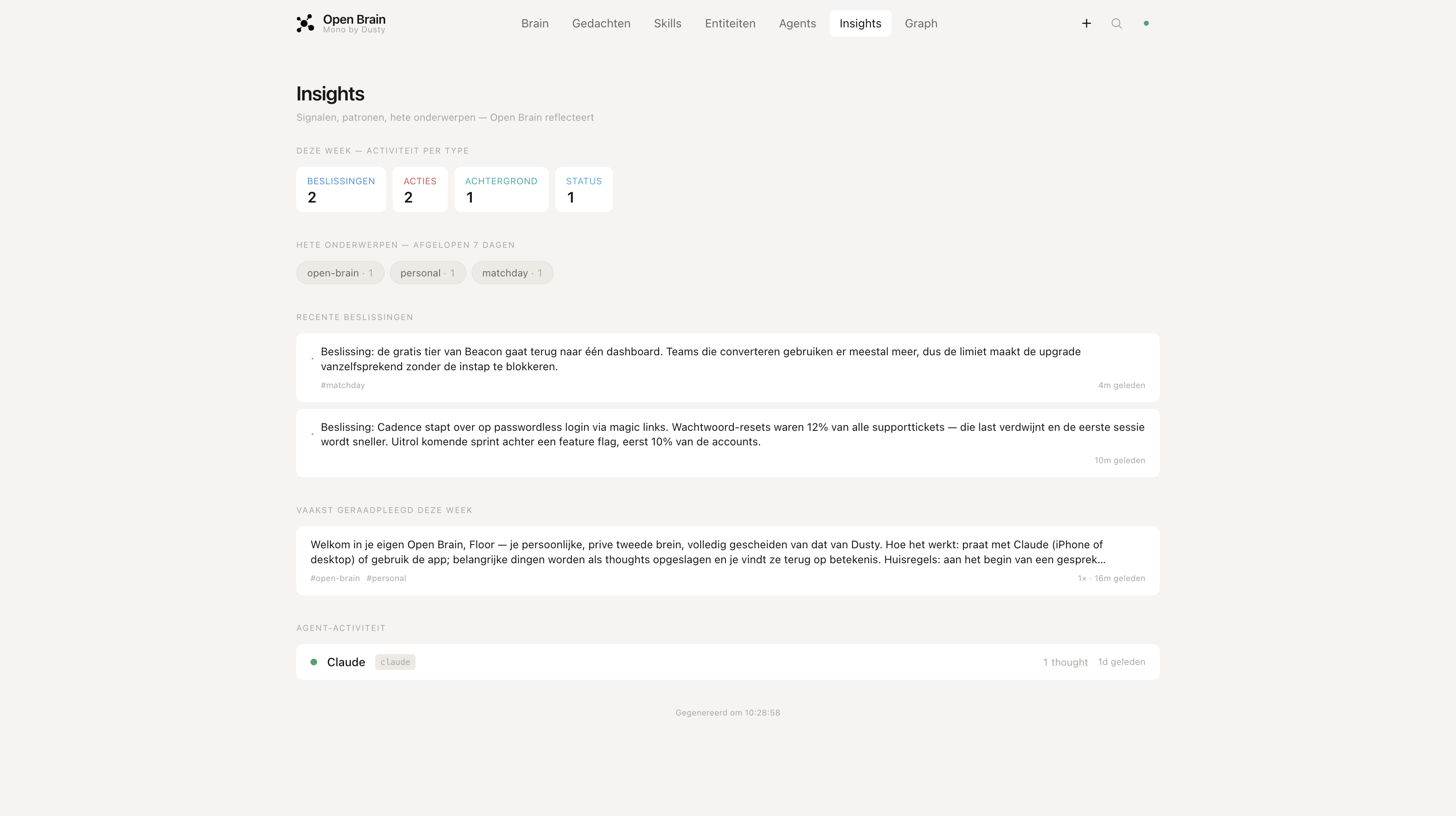
The memory talks back.

Open Brain surfaces patterns and signals on its own from what's been recorded. Not just storing, but noticing and pointing them out to you.

Key takeaway

The pile that every AI memory becomes, where nothing comes out in the end, stays away.

Open Brain — Insights
DecisionsActionsPatterns

Hunter strategy: inbound over active applying. Portfolio proof becomes the anchor.

decision8 Junimp 3

Mononium is the product name of the B2B AI photobooth SaaS. One source, all channels.

decision15 Junimp 2

04 · Agents

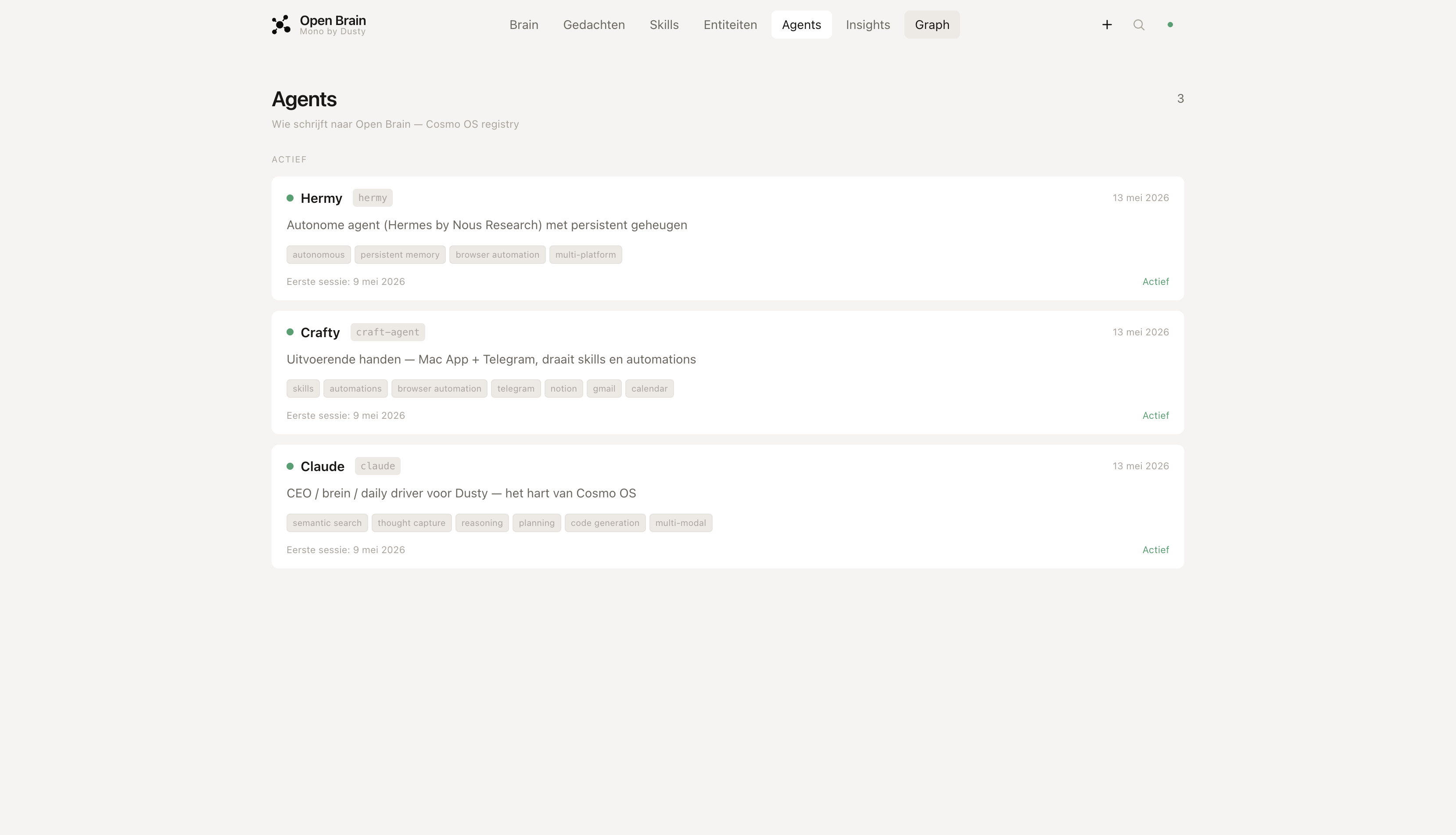
One source, no context loss.

Three agents, a daily driver, one that runs skills on the Mac, an autonomous background agent, all read from the same layer. What one records, the other knows straight away.

Key takeaway

No lock-in per vendor. The memory is yours, not the tool's.

Open Brain — Agents
C
Claude
CEO / brain / daily driver
active
Cr
Crafty
Mac & Telegram, runs skills
active
H
Hermy
Autonomous background agent
active
05 · Skills

After months, the system suggests work of its own.

From actions you keep repeating, Open Brain distils skills and tasks, and suggests them to you. The system grows with you instead of standing still.

Key takeaway

A tool that gets smarter the more you use it, not one you set up from scratch every time.

Open Brain — Skills
Skillsself-suggested
agenda-beheer
appointments into Apple Calendar
active
log-memortium-order
log orders correctly in Notion
active
weekreview-digest
from 9 repeating actions
suggested
06 · Mobile

The same layer, in your pocket.

A thought you capture on the go is ready on the Mac a minute later. The channel doesn't matter, the memory travels with you.

Key takeaway

You don't have to be at your desk to feed your second brain.

Captureon the go

Order Mea Vota closed and logged.

updateimp 2

Work block portfolio 08:30–10:30.

actiontoday

capturesearchrecent
Braintoday
412
Total
6
This week
14
Decision
5
Action
Thoughtdetail
Decision

Open Brain builds on MCP plus a REST fallback.

04 · under the hood

One layer. Many tools on top.

Storage on PostgreSQL with pgvector, embeddings through Voyage AI, deployment on Railway. Two entry points: an MCP connector for protocol-aware tools and a REST API for the rest. Retrieval is task-aware, with planning, reflection and briefing modes. A monthly decay process archives stale thoughts, a weekly consolidation clusters related ones into themes. Cost discipline sits in the design: embeddings batched and cached, retrieval summarising first before it expands.

Claude CodePostgreSQLpgvectorVoyage AIMCPREST APINode.jsRailway
05 · the proof
412
thoughts in continuous use
3
agents read from the layer daily
6+
applications unified
7
MCP tools exposed

This is the same architecture I'd put down in an organisation. Storage layer, embedding layer, retrieval modes, decay process, MCP and REST endpoints. What changes between personal and business use is the data source, the governance around it and the audit trail. Not the underlying design.

06 · the real thing

The real screens.

Not dressed up, just proof that it runs. This is the system as it stands day to day.

Brain
Real capture
assets/openbrain-01-brain.png
Brain

Brain. The daily overview.

Graph
Real capture
assets/openbrain-02-graph.png
Graph

Graph. The knowledge graph.

Insights
Real capture
assets/openbrain-03-insights.png
Insights

Insights. Patterns from the memory.

Agents
Real capture
assets/openbrain-04-agents.png
Agents

Agents. Three agents, one source.

07 · for organisations

The same layer, but for your organisation.

This is how I use Open Brain. But the layer is universal. At its core it's a general memory layer, and with the right MCP connections it becomes what you need. What I run solo runs just as well under a team, a department or a whole stack. It's the same architecture I'd put down in an organisation. What changes is the data source, the governance and the audit trail, not the design underneath.

Shared memory

One source, the whole team on it.

What one department or agent records is ready for the next. No knowledge stuck in one tool, or in one head.

Visibility on use

A dashboard from the background.

Who did what, which input went where, which agents talk to each other. Value from data that normally disappears unseen.

Compliance by design

Ready for the EU AI Act.

Logs and an audit trail per building block. Governance is woven into the layer, not stuck on top as a patch.

Endlessly deployable

Your use case shapes the form.

One universal layer. With good MCP connections it's exactly as broad or as specific as you want it.

The same layer beneath: supportsalesoperationsonboardingR&D

Pairs well with Mono Dash, the team of agents that works on top of it.

This is what a page can show. The rest I'll show you live.

Open Brain runs in production, with client data and my own work in it. If you want to see the layer really work, in between the tools, I'd rather do that live. One meeting, and you'll see it move.